History
1085 Norman Beginnings
According to the Worcester Monastic Annals the Benedictine monastery was founded in 1085.
The Priory was built for thirty monks and the church was much smaller than it is now. The areas coloured yellow in the plan on the right are part of the original building, itself part of a larger complex of monastery buildings. The picture (below right) shows the Norman Romanesque style pillars and arches.
Not long after the Battle of Hastings, Wulstan, the Bishop of Worcester, encouraged a monk called Aldwin to set up a small community of monks in the uninhabited area below the Malvern Hills. This area, stretching the full length of the hills, was declared a Royal Forest by King William, which meant it was an unenclosed woodland where wild animals were preserved for hunting.

The site chosen for the new monastery belonged to the manor of Powick which stretched up to the foothills of the Malvern Hills. Aldwin was probably from Powick and his family may have owned the land on which the monastery was built, which is why he is known as the founder. The manor of Powick came under the jurisdiction of Westminster Abbey, and this explains why the monastery was a priory, or daughter church, of this great abbey. In the 1120s, the abbey gave the manor of Powick to Malvern Priory for an annual rent of £24, an arrangement which continued until the Dissolution in 1539.
Having allegiance to Westminster Abbey rather than Worcester Cathedral led to altercations between the Priory and the Bishop of Worcester over the years. It is reported that in 1286 the Archbishop, the King and even the Pope were involved in these disagreements.

The picture (right) shows one bay of a two bay sunken chantry alongside St Anne`s chapel. You can see two coffin lids, one of which records an epitaph to Prior Walcher, Malvern’s second prior, who died in 1135. He was Malvern's most outstanding scholar and the first man in the western world to record the use of the astrolabe, an early form of sextant marked in degrees. He was also responsible for introducing the use of Arabic numerals to England, which eventually replaced the cumbersome Latin numbers.
Read this article on his work (pdf file).

1440 - 1500
The priory church was rebuilt in the latest Perpendicular style in this period. The Duke of Gloucester, later Richard III, and King Henry VII both donated glass for two of our great windows, that at the west end and the one in the north transept. You can see a sample of these windows on the Stained Glass page.
The north aisle was also extended and the new shape of the Priory is indicated by the blue colour on the plan. Widening of the south aisle was prevented by the cloisters and other monastery buildings.
Floor and wall tiles, along with the delightful monk's stalls were added at this time.
The Norman church was extended in the years between 1440 and 1500. There is an interesting study into the rebuilding of Great Malvern Priory in 15th Century.
1539 and Henry VIII
(I) During the 1530s King Henry VIII was short of cash and since the monasteries belonged to someone else (the Pope) he decided to plunder them. All opposition was brushed aside by Thomas Cromwell and in 1539 the Malvern monks surrendered their lands and buildings. These were leased and sold to various people. The exception was the monastic church which belonged to the crown.
(II) Destruction began; one man paid a pound for the Lady chapel and destroyed it. The cloisters and the South transept were pulled down and the lead removed from the roofs.
(III) The Priory church was saved by the parishioners of Malvern. Their own smaller parish church was in poor condition. It stood where the main Malvern post office is now. The parishioners, led by John Pope, petitioned the King and succeeded in buying the Priory church for £20. This large sum could only be paid in two instalments. The parish consisted of only 105 families and after they had bought the church, they had no money left to carry out proper repairs caused by the earlier destruction.
It is an interesting fact that we have, in the Priory, a monument to John Knotsford. He acquired what was left of the priory in 1545 and he and his family moved into the former Prior’s house, so helping to preserve what was left of the priory. John's daughter, Anne Savage, gave the impressive monument (pictured on right) with herself kneeling at the foot of the tomb.

1540 -1800
Lack of money continued to be a problem over the next couple of centuries. This meant that hardly any repairs or maintenance were carried out. On the plus side there was no money to remove the 'Popish' medieval glass so it is still with us.
Although the Civil War raged in nearby Worcester, Malvern was still in a remote part of the English countryside and the church and village were hardly touched by the war.
The picture is a view of the Priory in 1782, from an etching made at that time.

1860 Restoration and Repair
We are not sure who financed this work but this was the age of the industrial revolution and wealthy businessmen clearly made possible this renewal. Malvern was attracting many wealthy families to participate in the Water Cure too. Details in the stained glass windows of the nave, and tiles on ceiling and floor, bear witness to their generosity. The work was the responsibility of the well-known architect Sir Gilbert Scott. On the right is a picture of the ceiling put in at this time.
Queen Victoria’s jubilees in 1887 and 1897 saw the installation of new stained glass windows commemorating her reign.
The North Porch was rebuilt in 1894 and has recently benefited from further restoration. During the Great War, after much storm damage, a programme of re-leading the windows was carried out.

1939-45 World War II
During World War II the stained glass was removed and stored in zinc lined boxes which aided their preservation. After the war Dr L A Hamand, the organist, painstakingly replaced the stained glass windows in their original positions as far as was possible.

1977
In 1977 over £100,000 was raised for urgent repairs to stonework and re-leading of the glass. This never-ending preservation work continues today.
2003
Installation of the Millennium Windows by Tom Denny (given by The Friends of Malvern Priory).

2019
The North Porch stonework needed urgent repair to make it safe and at the same time, the whole porch was carefully cleaned to restore it to its former glory.
The masons were excited to find that the sizable carved canopy above the virgin and child is extremely ornate and has traces of red paint. They believed it probably dates from the 1500s and is carved from high quality Normandy limestone (the rest of the Porch is sandstone). Analysis of small samples of this red paint and paint from other areas of the porch revealed an earlier coat of stone-coloured limewash, under a coat of white paint, followed by two coats of red paint based on iron oxides. The figures are caved from red sandstone and have been painted with a stone coloured oil paint containing yellow and brown iron oxides. Significant traces of this paint remains.
At the same time, the West wall was significantly strengthened and repaired. Both projects were partly funded from the Heritage Lottery Fund, other grant making bodies and a grant of £10,000 from The Friends.

Madonna and child.

Detail of North Porch showing medieval paint.

2022
A start is being made on the conservation and environmental protection of the Priory's medieval stained glass windows.
Appropriately enough, the Creation Window is the first window to be cleaned and protected.

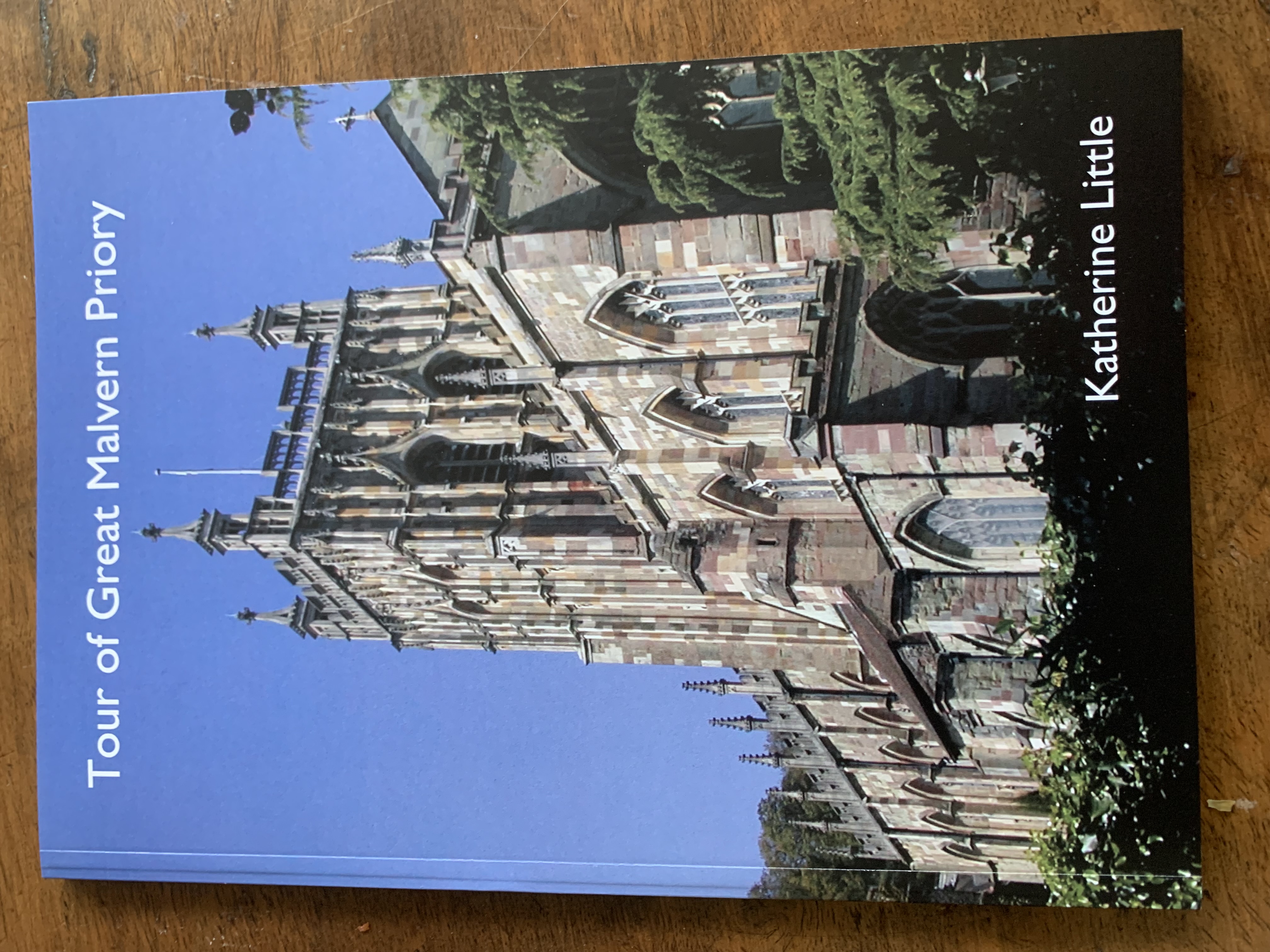

A Tour of Malvern Priory
A newly updated (2023) guidebook for the Priory by Katherine Little Is available from The Friends' Shop in the Priory for £5.